 USD


SBS120 Hydraulic Pump Gasket 129-7855/129-7857
- Description
Product Overview
This SBS120 hydraulic pump gasket set — the 129-7855 pump gasket — seals the joints on the main hydraulic pump of Cat E320C and E320D excavators. It is the set that comes off and goes back on whenever the pump is split for a shaft seal, a bearing or a rotating group repair, and it is the piece most often left out when a rebuild is rushed.
In the pack you get pre-cut black gasket pieces: a large outer gasket with round mounting holes punched around the edge, and a smaller rectangular section that closes the centre of the joint. Both are cut to the outline of the pump body, so there is no trimming or cutting to shape at the bench.
Fitters order an E320D hydraulic pump gasket most often after a body joint starts weeping oil, or after a pressure complaint that traces back to the main pump. It is a small part of the repair bill and a large part of whether the repair holds.
Workshops buy a set for the machine on the floor; parts counters keep a handful on the shelf. Nothing changes between the two — one build, one reference, the same set whether it goes out singly or by the box.
A compressed gasket does not seal twice. Once the pump has been torqued down, the sheet takes a set to the face, and re-using it or cutting a replacement from sheet is the usual reason a pump is wet again a few weeks after a repair.
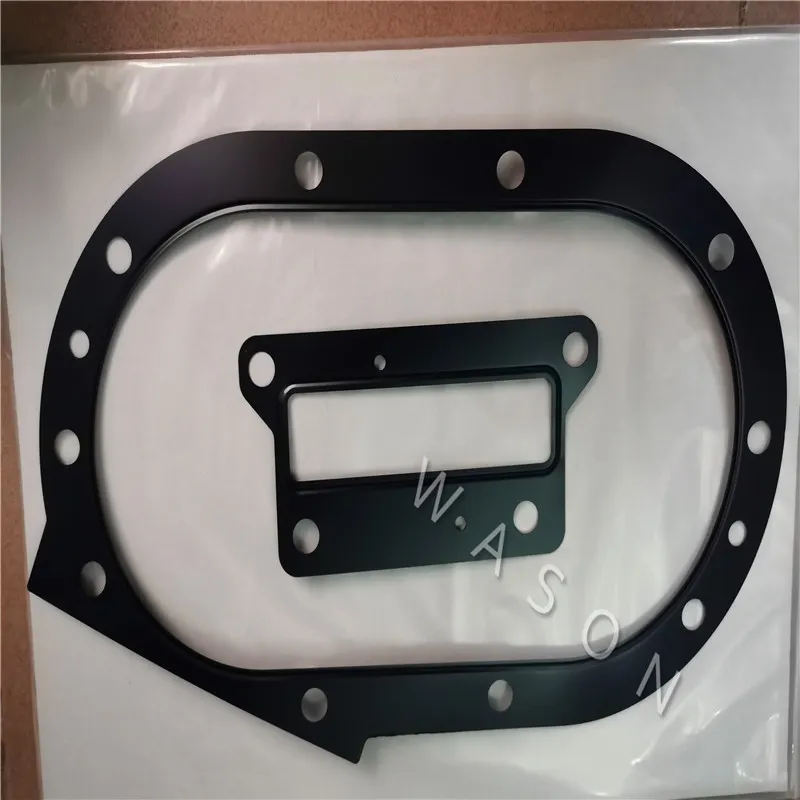
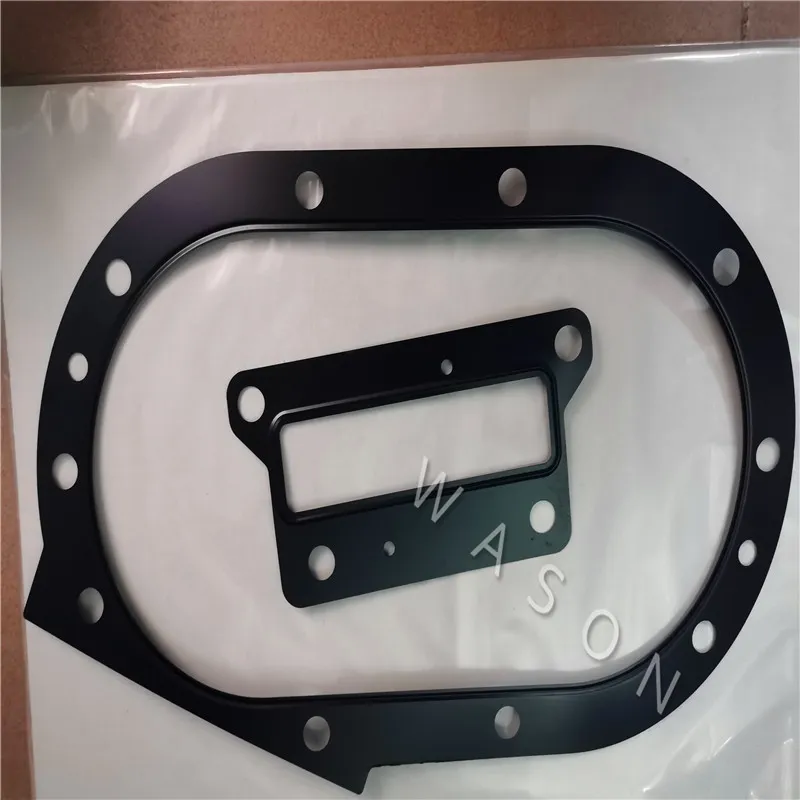
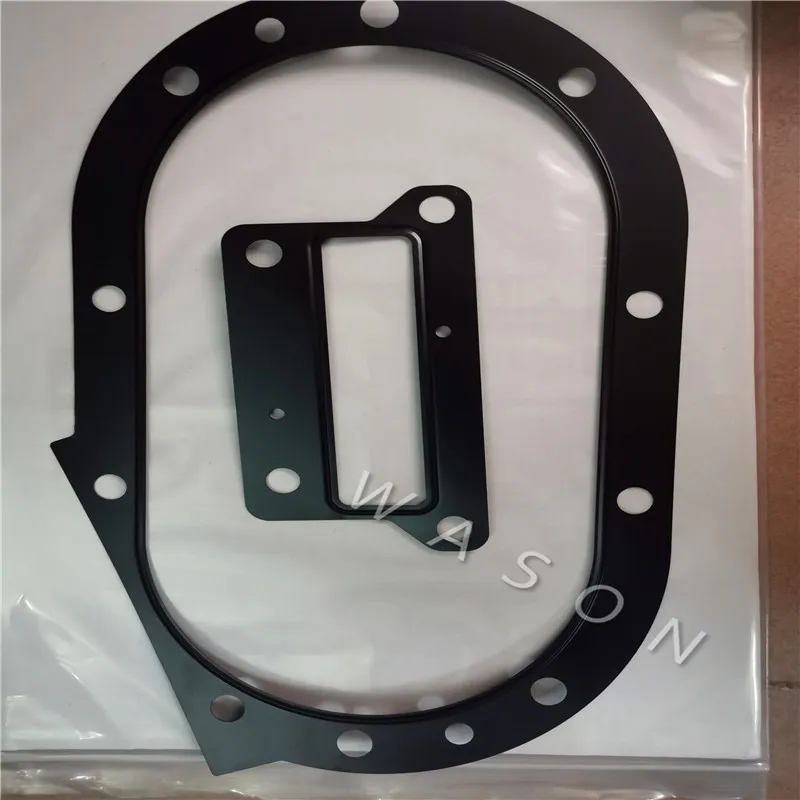
Gasket Construction & Sealing Face
The pieces are cut from black gasket sheet with a flat, matte face on both sides. The cut edges are clean and square rather than torn, which matters most at the holes, where a frayed edge gives oil a path straight through the joint. Each piece is a single flat sheet with no folded or laminated sections, so it compresses evenly once the pump body is torqued down. Check the set when it arrives: a crease or a bent corner will not flatten out under torque and should be replaced before fitting. The punched holes are what locate the gasket on the pump body, so the hole pattern is the part to look at hardest. Drop the set onto the bolt holes dry — if it has to be stretched to reach, the reference is wrong. Ours is cut to that same outline, which is why the cross-reference list below is so long — one joint sold under many numbers. The same construction goes out whether the order is a single-machine repair, a stocked SBS120 pump gasket or an E320D hydraulic pump gasket, with no separate budget grade to watch for.
Bench Inspection Checks
- Every set is laid out on the bench and checked piece by piece against a known-good sample of the same reference before it is packed.
- The outer outline is compared first. A gasket cut from the wrong profile shows up immediately at the corners and around the widest part of the flange.
- Each mounting hole is checked for position and for a clean punched edge. A torn or half-cut hole is rejected rather than trimmed to fit.
- The pieces are then checked for flatness. Anything that has picked up a crease in storage comes out of the batch, because a crease will not flatten under torque.
- The set count is confirmed — outer gasket and inner section together in one sleeve — so nobody opens a pack on the machine and finds a piece missing.
- Last comes the label. The number printed on the sleeve has to match the order, so a workshop fitting one machine and a buyer ordering a set of SBS120 pump gaskets both open the right reference.
Fitment & Machine Models
- Cat E320C. This is the Cat E320C pump gasket reference for the SBS120 main pump: the outer gasket follows the body outline and the mounting holes line up with the bolt pattern, so the cover drops back on without forcing.
- Cat E320D. Listed for E320D machines as well, and the E320D hydraulic pump gasket uses the same SBS120 body outline. If the pump has been replaced at some point in the machine's life, read the code plate on the pump itself rather than matching on the model badge.
- SBS120 main pump only. The set belongs to the SBS120 main pump body joints, not to the travel motor, swing motor or control valve sections, which use different outlines and will not interchange.
- Start with the old part. The quickest check is the number on the gasket being removed, read against the cross-reference list below. Where the number has worn away, a photo of the old piece with a straight rule laid beside it gives the same answer.
- Shape check on the bench. Lay the new set over the old one: outline, hole positions and the inner cut-out should sit on top of each other without overlap or gap.
- Comparing options. If you’re weighing one excavator pump gasket option against another, ask for the same three things — machine model, pump code and cross-reference number — and go with the one that comes back with a confirmed match.
- Scope of the set. This covers the flat gasket joints. Shaft seals, O-rings and other soft parts for the same pump are separate items, so plan the whole reseal before the pump comes off the machine.
Part Number Cross-Reference
| Specification | Detail |
|---|---|
| Alternate part numbers (1 of 5) | 4976170F, C3926722, 3909410, 3627938, 207515 |
| Alternate part numbers (2 of 5) | 206973, 3637731, 3637727, 151900, 4943051 |
| Alternate part numbers (3 of 5) | 5257187, 3959052, 3401290, 10817200, 4890832С |
| Alternate part numbers (4 of 5) | 2888747, 3968562С, 393448600, 109080, 208128 |
| Alternate part numbers (5 of 5) | 216487, 67946, 157551, A3902666, 215705 |
| Pump family | SBS120 |
| Machine fitment | Cat E320C / Cat E320D |
| Reference numbers | 129-7855 pump gasket, 129-7857 |
| Part type | Aftermarket replacement main pump gasket |
| Supplied as | One pre-cut set |
Workshop Replacement Sequence
- Park the machine on level ground, let the hydraulic oil cool, and isolate the system before anything is opened. Hot oil is the reason a straightforward pump job turns into an injury.
- Read the number on the gasket you are removing and put the old part beside the new set. Outline, hole positions and inner cut-out should match before anything is cleaned.
- Compare the old gasket against the profile used for the original hydraulic pump gasket. If the new set sits proud at one corner or the holes are visibly off, stop and check the reference rather than forcing it on.
- Clean both mating faces back to bare metal. Old gasket material, sealant residue and paint all have to go, and a scraper should never dig into the face — a gouge becomes a leak path no gasket can fill.
- Run a straight edge across both faces to check for distortion. A raised or dished area on the pump body will leak with a new gasket just as it did with the old one.
- On a Cat E320C the Cat E320C pump gasket set should drop onto the bolt holes without stretching or lifting. Once it is seated, check that no part of it is pinched between the faces before the body goes back together.
- Torque the body down in the order the service manual gives, refill, and run the machine up to temperature before calling the job done. Every excavator hydraulic pump gasket joint behaves the same way: clean faces, an undistorted gasket and even torque, or the oil comes back.
Leak Diagnosis & Recheck
| Symptom | What to check |
| Oil at the body joint face | Clean the pump, run it and watch where the oil reappears — a shaft seal or an adjacent cover can look like a joint leak from above. |
| Oil around the bolt heads | Oil travelling along a bolt thread usually starts at the joint face, so check the joint before condemning the bolts. |
| Oil misting around the pump | Suction hose, inlet fitting or shaft seal; the body gaskets are not the source of this one. |
| Leak only when the machine is hot | A joint that opens with heat was rarely flat to begin with — check both faces with a straight edge once the pump is off. |
| Leak only when the machine is working | Pressure-related; check the relief settings and the pump's own condition before blaming the gasket. |
| New set fitted and the joint is still wet | Reference mismatch: a Cat E320C pump gasket that does not match the outline will never seat, however carefully it is fitted. |
| Wet on one side, dry on the other | Uneven torque or a distorted face; a second gasket will not correct either. |
| Leak returns on every rebuild | The mating face is damaged — scored, gouged or out of flat — and needs machining or replacement before a gasket can hold. |
Ordering & Dispatch
- Send three things. Machine model, pump code and the number from the old gasket. That combination is what confirms the reference; a model badge on its own can point to more than one pump.
- Ask us directly. Whether you are dealing with us or with another seller of excavator pump gaskets, the answer you want is a confirmed number, not a "probably fits".
- Reference to quote. If your parts book shows the 129-7855 pump gasket, quote that number and we will match the set to it.
- Quantity and price. Single sets and larger quantities of the SBS120 pump gasket are both available; ask your sales contact for the current price at the quantity you need.
- Availability and lead time. Confirm current stock and dispatch timing before you book the machine into the workshop, especially if the pump is already off.
- Packing. Sets travel in a clear sleeve on a cardboard backing with the reference printed on the outside, so the number stays readable in a parts bin.
- Payment, shipping and paperwork. Confirm the terms for your order — payment method, shipping arrangement and the documents you need for import — with your sales contact before dispatch.
Scale & Supply Capability
Guangzhou Wason has been providing construction machinery parts since 2015. As a hydraulic pump gasket specialist we draw on a broad network of trusted partners and hold stock for fast dispatch, so common items move without long waits. Our catalogue covers the replacement parts we list, and we help customers combine mixed orders, check samples before dispatch and coordinate customized requirements when a standard item will not do. Customers across Africa, the Middle East and South America rely on us for steady supply, careful inspection and export paperwork handled end to end.


